Dream Scenario: Getting Cagey about fantasies of alienation and escape

Ian Parker watched a crappy film which got under his skin

Dream Scenario, released at the end of last year, stars Nicolas Cage as Paul Matthews, a college professor seething with resentment at not being recognised for a book he has not even started writing, and then paying a horrible price for being noticed, more than he would have liked. Paul lumbers around the sets with a goofy expression and an anorak pasted onto his back, and gives fake “inspirational” lectures (the staple of Hollywood films about college professors) about how zebras blend into the herd to stay safe and only stand out in order to mate.

Scenarios

Things start going awry when Cage, who is also producer of the film, starts appearing in people’s dream, not doing much, but as a passive onlooker. It’s creepy. People start to compare notes, and Paul can’t resist seizing this opportunity to break out of dumb anonymity into being a celebrity and, his game-plan, to get a contract for his book on evolutionary biology. An agency takes him on, offering him a deal to promote Sprite in peoples’ dreams, which he objects to, or to appear in Obama’s dream, which he likes the sound of.

Paul Matthews does become a celebrity, but people are frightened, and when he is singled out, he reacts, and when he reacts he is perceived, dreamt of, as being violent, and then he is scapegoated – the celebrity becomes a threat – and feared. Along the way there is a ghastly sex-scene when one dreamer tries to get Paul to enact the experience they had fantasised about with him, and one reviewer remarks that you will want to take a pen-knife to scrape away the memory of the scene (and they are right).

You will watch all this unroll for the first agonising four fifths of the film before the narrative lurches into a daft alternative near-future scenario in which people are able to use new technology to leap into others’ dreams. There are ironic references to the commodification of life, but any progressive reading is wiped away, and you are left with the kind of hopelessness that Paul is wallowing in at the start of the film.

Alienation

There is something intriguing about all this because it taps into something of the formation and experience of subjectivity under capitalism. This is a film about alienation in a number of key aspects. One is the reduction of people to being passive spectators, but that passivity, as we can see in the case of Paul, is laced with anger that cannot be channelled into productive activity. It is incited and blocked. People become ill as a result.

Another aspect is anonymity, the kind of thing that was described in US American sociology as the phenomenon of the “lonely crowd,” in which we are living alongside other people without really relating to them, and that lack of recognition also feeds into a sense of being isolated and helpless. Paul craves recognition for his achievements but cannot do anything to break out of his little prison.

The third aspect of alienation is atomisation, the imprisonment in the sense of “individuality” that is promoted as a vision of autonomy and freedom but which actually divides people from each other. This is where Paul’s passionate lecture, which he is fixated upon – he repeats it during the course of the disastrous date with an admiring dreamer – is so emblematic; zebras blend in to stay safe and stand out to get sex, excitement with others.

These three aspects of alienation are at the heart of the escape attempts that are provoked in us, that we might break out, become active, that we might actually link up with others, gain recognition, and that we might realise ourselves as fully human and – here is a trap – become fully independent.

That third escape attempt, and here in the film it is to become a “celebrity” (like Cage is in real life, in a fake-reflexive twist on the ideological core of the film), and so we become all the more locked into the forms of individuality that are provoked by capitalism and intensified under neoliberalism, locked into our little selves instead of becoming human as part of a constructed collective endeavour.

Dreams

This is where dreams come in, and they are not only explicitly a topic of the film Dream Scenario, but we are offered a “theory”, if you can call it that, for how all this works. In the even more crappy final fifth of the film someone marketing the new technology that allows everyone, and not only Nicolas Cage, to enter other peoples’ dreams, opines that the real lesson of Paul Matthews’ celebrity appearance in dreams is that “dualism” – the split between our bodies and our minds, between material reality and the ideas we have about it, is true. More than that, there are specific “theories” that also turn out to be true. Enter stage right one of the ideological master-keys to dreams and our unconscious fantasies, psychoanalysis.

Dream Scenario peddles not only dualism, an ideology about who we are in the world that divides us from it, but also banalised versions of psychoanalytic theory. First off, and this is voiced quite explicitly by some of the characters to explain how Paul Matthews appears in their dreams, is Jung. Carl Jung, who talked about a “collective unconscious” that was “racial”, and who came out with antisemitic and other racist comments during his time as head of the Nazi-controlled psychotherapy organisation in Germany after Freud and his followers were hounded out, is a go-to for some of the most reactionary ideas about our yearning for individuality, collectivity and change.

Here in “Dream Scenario” Jung’s ideas are wheeled in to not only account for the weird events in the first four fifths of the film but actually to advertise the possibility of telepathically-shared dream worlds (even if there are also some little digs at the way that commercial enterprises might harness that to their own ends).

The other psychoanalytic element is hinted it, and actually ideologically underpins how Paul projects himself into dreams. This element comes from the work of Melanie Klein, one of the most biologically-reductive of present-day psychoanalysts, with a mainly conservative influence, following her death, in psychoanalytic organisations around the world. She argued that through what she called “projective identification” it would be possible for fantasies to be conveyed from one mind to another, most significantly, for her, from the mind of the psychoanalytic patient who would “project” feelings into the mind of the psychoanalyst, would then “identify” with them. This daft idea is also, of course, of a piece with dualism, with the independent life of ideas and their circulation outside of material reality.

Some of my psychoanalytic colleagues will tell me that they reach for Jungian and Kleinian ideas in their own work and find them useful. That’s fine, but here in this film we are given an opportunity to notice how those ideas also play out ideologically in popular culture outside the clinic. The real problem is when specific techniques are turned into a complete worldview (and in this case, two complementary psychoanalytic worldviews) that is functional to capitalism.

Real life

So, though Paul Matthews tells us about zebras, and wants to write a book about evolutionary biology, the “explanation” we are sold, under the counter as it were, is a quasi-psychoanalytic one. Dream on. This film might be a critique of alienation, but it offers us no way out, only the fantasy that we might peel off that anorak and turn out to be not Paul Matthews but a famous real-life film producer Nicolas Cage. Avoid it, or, if you are tempted, step back and think critically about what you are being sold in this film, and look to quite different scenarios for combatting alienation, ones that are constructed collectively in our real lives together rather than searching for only fantasied individual ways out.

You can read and comment on this where it was first published here

Betrayal as liberation: Marxism, psychoanalysis and Irish struggles in Mexican history

[This text was the intervention of David Pavón-Cuéllar for the 6 July 2023 ‘Psychoanalysis and Revolution in Ireland’ symposium, the complete video-recording of which is here]

Somewhere in our Manifesto Psychoanalysis and revolution: critical psychology for liberation movements, Ian Parker and I consider how our ego dominates us, how it betrays us by dominating us, and how we can free ourselves from it through liberation movements. Liberating ourselves is here freeing ourselves from our ego that appears as our master who betrays us and through which we betray ourselves. As always with our masters, we must choose between them and us: either they betray us or we betray them; either we betray ourselves by submitting to them, or we free ourselves from them by betraying them.

We must betray our masters to free ourselves from them. One of the reasons why our liberation is so difficult is because it implies a betrayal, a treason to the master and what is of the master within us, precisely in the form of the ego. Betraying and betraying yourself is not easy, no matter how liberating it is.

I will give betrayal a positive meaning, when the usual thing is that we give it only a negative meaning, such as when we feel that we have been betrayed by someone. I guess this feeling is known to all of us. I felt it, for example, when I was about twenty years old and I read Marx and especially Engels celebrating the United States when it invaded my country, Mexico, in 1846, stealing half of our territory. This first US imperialist intervention in Latin America was being supported by the referents of our Latin American anti-imperialism.

How could someone like me, a young Latin American Marxist, not feel betrayed in his anti-imperialism, betrayed in his desire that he imagined shared with Marx and Engels? I remember that I accused Marx and Engels of the only thing for which one can be guilty for Jacques Lacan. Marx and Engels had been guilty of giving in to their desire, our desire, and thus they would have betrayed us, Latin American Marxists.

Lacan observes that there is always some kind of betrayal in giving in to our desire. This was the betrayal I accused Marx and Engels of when I was a young 20-year-old Marxist.

I’m sure the Irish Marxists would understand me. It is as if Marx and Engels had supported British colonialism in Ireland. However, as we know, you had better luck than us. Marx and Engels strongly supported Irish independence from the 1850s.

Why weren’t you betrayed like us by Marx and Engels? I think that one of the reasons was the moment in which Marx and Engels spoke about each case. As Pedro Scaron has shown, there is a development in the opinions of Marx and Engels on colonialism, from the insensitivity to the Mexican case to openly anti-colonial positions since the Irish case. It is almost as if Ireland has taught Marx and Engels their anti-colonialism that will later be so important to our Global South.

What is certain is that the Irish were ahead of Marx and Engels in the awareness of what was at stake in colonialism. This can be verified in the United States intervention in Mexico in 1846, when hundreds of Irish soldiers deserted the United States Army and enlisted in the Saint Patrick’s Battalion to defend the Mexicans with whom they identified, just as they associated the American invaders with the English oppressors in Ireland. Many Irish lost their lives fighting for Mexico in the Saint Patrick’s Battalion, which also included German, Scottish and English soldiers in a spirit that we would describe today as “internationalist”. Of the few survivors, fifty Irishmen will be hanged by the United States Army. The gallows were their punishment as guilty of treason, yes, treason, but a treason that has nothing to do with the treason that I imputed to Marx and Engels when I was young.

Thirty years ago, I felt that Marx and Engels betrayed because they betrayed our desire. On the contrary, the Irish were considered traitors because they had followed their desire, which led them to betray the United States, the United States Army, the United States Army generals. The Irish in Mexico betrayed their masters to follow their desire, not to give in to it, not to betray themselves.

It was to fight for their desire for freedom that the Irish had to betray their oppressor in 1846. It is not the first time they have done so in Mexico. Twenty-five years earlier, Mexico had gained its independence from Spain in part thanks to the last Spanish viceroy, Juan O’Donojú, son of Irish noblemen Richard O’Donnohue, from County Limerick, and Alicia O’Ryan, from county Kerry, who had to take refuge in Spain to flee from the persecution against the Catholics by Kings George I and George II of Great Britain.

Perhaps the legacy of persecution was what made Juan O’Donojú fight for freedom first against the French invaders in Spain and then against the absolutism of the Spanish crown. This caused him to be imprisoned and tortured twice. Then, as the highest Spanish authority in Mexico, he knew how to listen to ten years of Mexican struggles against Spain and signed the Mexican independence act just before he died. He was also considered a traitor in Spain.

Betrayal against Spain was the only way O’Donojú could be on the good side of history. This side is always that of desire, but also that of freedom. It is the side of those who want to be free, of the oppressed people, whether they are the colonized by Spain, the Jews in the Nazi regime, the Palestinians in Israel or the African immigrants in France or in any other European country. The side of these oppressed people can only be a trench against their oppressors. Defeating the Spanish oppressors required betraying them.

The betrayal by O’Donojú against the Crown of Spain was the same liberating betrayal that another Irishman committed in Mexico, William Lamport, born in Wexford at the beginning of the 17th century, in the bosom of a noble Catholic family. openly hostile to the English occupation of Ireland. First William, as a student in London, was sentenced to death for writing a text against England, but he managed to flee to Spain. Then he arrived in Mexico and planned to pose as the son of the King of Spain in order to rule the Spanish colony and thus be able to free indigenous, black and mestizos. His plan was discovered and he was burned to death at the stake.

Like the 50 Irish soldiers hanged in 1847, the Irish nobleman William Lamport was burned to death in Mexico in 1659. Thus he lost his ego for remaining faithful to us. By not betraying us, he betrayed his master, Spain.

Lamport’s crime was also betraying the oppressor, allying himself with the oppressed, fighting for his desire for freedom. His fault was paradoxically not being guilty of giving in to his desire. It was for not being guilty in the eyes of psychoanalysis that Lamport was guilty in the eyes of power.

Lamport’s political program is evident in his writings in which he presents himself as a forerunner of our anti-racist, anti-colonial and anti-imperialist struggles. The desire for freedom and equality is eloquently manifested in his psalm number 632. There he recalls that Africans “were born free” like other human beings, that “it was not lawful” to reduce them to “cruel servitude” just as it would not be lawful for them to made us “captives”, and he asks the Mexicans why they buy Ethiopians when they don’t want to be “bought by them”.

Defending an equal freedom for all, a freedom in equality, William Lamport addresses the Mexicans, the subjects who identify with the Spanish master, and puts them in their place, in the place of subjects. What he does is not simply tell them not to do to others what they don’t want done to them. It is not just asking them to put themselves in the place of others either. It is something more radical: it is telling them that their place is that of the others, that of the subjects, and not that of the masters. It is as if we told Nazis that their place is that of the Jews, or Israeli soldiers that their place is that of the Palestinian they murder, or French policemen that their place is that of the immigrant they shoot.

Our true place is always the one of the subject and not that of the master, that of the oppressed and not that of the oppressors. This place of our truth is the one from which Lamport spoke. It was a place that he knew very well, perhaps because he was an Irishman persecuted by the English crown, or perhaps because he was mad. It must be said that Lamport was what we would describe today as a psychotic. He had what we call delusions and hallucinations.

Sometimes we must be mad to be in the truth. Sometimes the truth is what drives us mad. We don’t know exactly if this was what happened to Lamport. What we do know is that his madness made him speak truthfully –with the truth of his desire for equality and freedom– by translating and betraying the discourse of the master, the discourse of power and knowledge, the discourse of the monarchy and Catholicism. His fervent religiousness and his aspiration to be king were the theatrical staging in which he could articulate his desire. They were the knowledge that he could subvert by expressing his truth. They were the discourse in which he could speak. They were what was to be translated and could be betrayed by being translated.

Lamport’s translation and betrayal was carefully scrutinized by the Inquisition. The inquisitors listened to Lamport, they heard the truth of his desire, and for that they sentenced him to the stake. Today his delusions would have been listened to by a psychologist or a psychiatrist who would have sentenced him to psychiatric hospitalization. The truth always has to be silenced. It is something typical of modernity, since classical times, especially since the 17th century, as Foucault shows us precisely in that century of Lamport.

In the same 17th century, in a scene underlined by Lacan, the Spanish Jesuit Baltasar Gracián tells how the truth terrifies and makes us escape from it. We can’t stand the truth and now we persecute it with psychology or psychiatry as before with the Inquisition. This was also understood very well by Foucault, who also understood that psychoanalysis should be something different. Psychoanalysis should allow us to listen to the truth, the truth of desire, of the symptom, of the word of the subjects who betray the master’s discourse by trying to translate it.

By betraying the discourse of the master, we are in what Lacan called the discourse of the hysteric. This discourse of subversion is at the origin of any revolutionary movement. The revolution begins by expressing and listening to a desire. Then this desire is what allows the revolution to remain open, to describe a spiral movement, to become a permanent revolution instead of returning to its starting point and reconstituting the master’s discourse. All this is what Lacan tells us when explaining what he himself describes as the interest of psychoanalysis for the revolution: an interest consisting in allowing the expression and listening of the desire that keeps the revolutionary circle open.

What psychoanalysis does is hysterize us and sustain the discourse of the hysteric. In this discourse, it is we, subjects, who speak instead of the master, instead of the ego, by usurping his position as master, just as Lamport tried to usurp the place of the king. Only in this way can we express ourselves as subjects when expressing our desire, expressing ourselves as desiring subjects, but also as divided subjects, traversed by power.

The division is flagrant in the case of Lamport. It is as the son of the king of Spain that Lamport wants to free the Mexicans from Spain. His belief in freedom is as solid as his belief in monarchy. His Catholicism is that of a heretic.

Lamport is a divided subject because he can only speak of liberty and equality in the discourse of the master, the discourse of the politics of his time, the discourse of the monarchy, of Catholicism and colonialism. It is the same thing that happened with Marx and Engels when referring to the US invasion of Mexico in 1846. Marx and Engels also required the discourse of the master, that of colonialism and imperialism, in order to express their desire that would end up becoming anti-colonialist and anti-imperialist.

We can say that Marx and Engels, like Lamport, gave in to their desire in order not to give in to their desire. They betrayed themselves in order not to betray themselves. They made concessions in order not to make concessions. This paradoxical ethics will be conceived by Lacan, in his eighth seminar, as the paradigmatic modern ethics, in contrast to the ancient ethics of the inflexible Antigone who does not give up anything on her desire. The new ethical figure is no longer Antigone, but a Claudel character, Sygne de Coufontaine, who agrees to marry her family’s worst enemy in order to preserve the family patrimony.

Sygne must give in to her desire in order not to give in to her desire to preserve the family heritage. Don’t we have here the realistic ethic, the ethic of real politics, of revolutionaries who must make concessions in order to advance the revolution, revolutionaries who must betray themselves in order not to betray themselves, who must deviate from the path towards the communist horizon in terrain as mountainous and rugged as reality? I am paraphrasing Lenin because he understood this new ethic very well. He understood it in his revolutionary strategy and made it explicit in his critique of leftist infantilism.

Lenin understood that Marx’s text itself had to be betrayed when translated into real politics. He glimpsed that there was oppression on the road to any liberation. For this and for more, Lenin spoke from the division of the subject. He accepted this division and assumed it as a contradiction in his materialist dialectic. It is the same thing that Marx and Engels did. It is for this and for more that today we should listen to them and take them seriously in psychoanalysis. This listening is at the base of our Manifesto.

[The Spanish version of David Pavón-Cuéllar’s intervention is here]

Translation and Revolution

[This text was the intervention of Ian Parker at the ‘Psychoanalysis and Revolution in Ireland’ symposium, the complete video-recording of which is here]

This book Psychoanalysis and Revolution: Critical Psychology for Liberation Movements is born of translation. I met up with my Mexican comrade David Pavón-Cuéllar in Havana back in 2019, and he told me there should be an accessible introduction to psychoanalysis for activists on the left. I said that we should write it together. We agreed that it should not be another Marxist or Freudian colonisation of political struggles, but that we should try and learn from those different struggles, and explain something of our struggle with psychoanalysis to those who are puzzled about what the big deal is, wonder why we are interested in all this stuff. We are not evangelists for psychoanalysis, or for Marxism for that matter, but we argue that there are some key ideas from psychoanalysis that are liberating, will help the cause of liberation, of revolution.

Outside language

Then the pandemic hit and we all experienced a simultaneous closing of borders and explosion of internet contact, of Zoom and the suchlike. And that meant that David and I wrote the book on email, shuttling the text back and forth between Manchester and Morelia. Our emails to each other are in Spanish, something I struggle with, and the text carries the traces of formulations in English English and Mexican Spanish, and, I suspect, in David’s French-accented Lacanese. We tried our best not to make the book read like a Lacanian book, but those of you who are on the look-out for it will find some of that jargon there too. The plan was that it should appear in Spanish and English, and if possible be translated into other languages, but the Russian publisher, who has now had to flee the country, was fast, was first.

We are translating all the time in the book, backwards and forwards between theories of liberation, of revolution, and theories of unconscious repetitive processes that drive us and, when they drive us into psychoanalysis to talk to a psychoanalyst, reappear in ‘transference’ so we can re-experience them there and reflect on them and do something different with them. That notion of ‘transference’ is perhaps the trickiest, the scariest, the one that operates in the clinic in the relationship between those who speak, the analysands, and those they speak to, the analysts. Those are little jargon words, of course, by the way; the psychoanalyst, or the analyst for short, is the one who often appears to be doing the analysis, and the analysand, the patient – an old medical hangover word there – is the one who actually analyses as they speak.

Anyway, back to transference. Stuff from the outside world gets translated into the clinical space, and our task as revolutionaries is, among other things, to ensure that it is not stuck there. So, as we talk about four key concepts of psychoanalysis in the book – unconscious, repetition, drive and transference – we are translating them into commonsense, to make them accessible, but then pulling back from that, worried that turning psychoanalysis into commonsense will defang it, simply turn it into ideology, pap. I want me pap! (Fail again, fail better.)

Here’s the thing. Revolution worth its salt should be all about translation. It is not a model that is transposed from one part of the world to another, good news about communism or feminism that we export and make appear in other languages; it is about what happens when we break out of our own language, our own way of doing things, and make that revolutionary change rebound from other places, allow it revolutionise ourselves, ourselves at home, at that place we think is home.

And psychoanalysis is all about translation. It is not at all about making us feel at home, but is about enabling us to live away from home, in diaspora, in exile, outside of that romanticised place we are tempted to retreat to, the impossible place that was never actually there in the past but which we might imagine we could return to. The questioning and self-questioning that psychoanalysis facilitates is something that does not rest but launches us into a different relationship with who we’ve been told we are, and it enables us to live with that. It is a relationship with the outside world we had to encounter when we grew up, otherness, and the otherness that became part of us as soon as we began to speak.

There is a fiction around, an ideological fiction that turns psychoanalysis into a comforting illusion compatible with all the mainstream pop-psychological stuff that is all around us now, the fiction that the psychoanalyst translates what the analysand, the patient, says, and turns it into an interpretation that they then feed back to bring about insight, interpretation delivered as a kind of colonising message about what the psychoanalyst knows, knows better. And, in its worst forms, the idea is that the psychoanalyst has good ideas and good morals, is a good moral character, been through their own analysis, cleansed, and so not only should the analysand believe what the analyst says, but they might try to find a way to cure by being like this good person who has told them how to think.

Then that really is close to the kind of colonising process that the revolutionary psychiatrist Frantz Fanon railed against. We think we are sometimes outside language, doing our thinking for ourselves, independent of others before we put our thoughts into words, but we are actually always inside language. The question is how we can open up contradictions so there is freedom of movement, and how we can do it in such a way that is attentive to the way that some people are locked in the language of colonisers, of those with power to define what language is and how a life should be spoken of.

Inside language

There is not only translation between languages, but translation inside a language. So, when a psychoanalyst is speaking about the difficulty of working in translation, with an analysand from a different language, say, they are actually encountering something of the nature of psychoanalysis as such. It is said that Freud put people on the couch because, as psychoanalysis gained in popularity, so many English-speaking visitors made up his case-load, babbling away in a language he had quite good knowledge of but was not completely fluent in; he said he could not bear to be stared at for all those hours in a day, but neither could he bear the exhausting task of responding face to face, showing that he understood what they were saying instead of listening in such a way as to enable translation as part of the psychoanalytic process, a crucial part of the psychoanalytic process.

The psychoanalyst should really know better than think they can deliver interpretations from on high, of course, and would know better if they were to take seriously what psychoanalysis tells them about translation. (A side note: Again and again when we English people visit the United States of America we are reminded that we are two countries divided by a common language; I have had this said to me by car hire or rental companies more than once, for example, when I am trying to work out what this or that rule means. Well, we learn something about translation inside language here.) When we are in psychoanalysis, and we are trying, impossible through it is, to obey the fundamental technical rule of psychoanalysis – free association, to speak freely, to say whatever comes into our mind however irrelevant or stupid or unpleasant it is – we learn something about translation ourselves.

So, together, but in different ways that cannot be directly translated between the two of us, the psychoanalyst and their analysand learn something about the nature of language as well as their own nature as human beings, the beings who speak. Here we make a psychoanalytically-informed differentiation, between translation conceived of as ‘communication’, as if there is some kind of magical transfusion of thoughts by way of words, and translation as transformation. It is intriguing to notice here something crucial in the history of psychoanalysis, how careful Freud himself was to distinguish psychoanalysis from telepathy. If telepathy actually happens, Freud thought – well, who knows what he thought, it is what he actually wrote we are concerned with here – then that would cause all kinds of problems for psychoanalysis. Indeed, what would be the point of psychoanalysis if there was direct communication of thoughts from one mind to another. And since Freud did indeed believe in telepathy, he made sure to prohibit discussion of it in psychoanalysis.

Psychoanalysis is not the same as telepathy, it is a completely different kettle of fish, a fishy kettleful of words jumbled up inside our heads and between us. The stuff of psychoanalysis is the language we use to try and communicate with each other and what we encounter in the language as a kind of barrier instead, as we would wish, a kind of conduit. We do not control the meaning of the words we use, and neither can we control what other people understand by them. And although psychoanalysis is often called the ‘talking cure’, a description that was given by one of the first patients to describe her own experience of the ‘chimney-sweeping’ she thought she was engaging in as she spoke to her doctor, it is not the putting of things into words that has a curative effect but the failure to put things into words and what we learn from that about our relation to others and what we learn about our relation to ourselves.

Conduits and barriers

So here we are, in a space in which there is indeed an illusion of communication, a necessary illusion in which I think I am conveying to you what I want to say and you are understanding it. That space, and the space in the clinic, is not a level playing field, not an open free space in which the words travel around the ground as on a smooth surface. That space, and the clinic in that space, are historically structured spaces, structured by historically-given forms of power; the power of men who believe they speak less than women but actually empirically speak more, the power of those in the colonial realms who believe they have the right to be heard, and so on.

It is sometimes said that a translator is a traitor, that the process of turning one language into another must necessarily involve a degree of twisting and turning. I am cool with that. In fact, I welcome that what might appear in another translation of the link between Psychoanalysis and Revolution might be genuinely revolutionary and genuinely psychoanalytic, in the sense that, in order to be heard in a different context, to be heard in a different language, something new appears, and what is new then turns back and questions, rebels. Tell us something we don’t know.

We don’t speak in conditions of our own choosing. That was a lesson of revolutions, and is also a lesson from psychoanalysis.

The Autism Industrial Complex

Alicia Broderick’s book is reviewed by Ian Parker

This book grounds the emergence and possible radical responses to autism in political economy, and sets the groundwork for discussion among revolutionary Marxists about how they might engage with one of the new identities that both hinder and mobilise people to think critically about the nature of capitalism. Alicia Broderick’s 2022 The Autism Industrial Complex carries the ambitious subtitle ‘How Branding, Marketing, and Capital Investment Turned Autism into Big Business’. It promises a lot, building on a very interesting and well-received co-authored article published last year.

What it is

The book refuses to go down the rabbit-hole of asking what ‘autism’ really is, with a neat overview of the way that the category emerged pretty-well simultaneously in the 1940s in Nazi Germany and in the ‘democratic’ United States. You will find plenty of descriptions of what autism ‘is’ online. The descriptions seem certain and ‘scientific’. They are not. The phenomenon emerged at a certain point in time in a certain context; it is historical not biological.

There is a misstep at this point in the argument, though, with the claim that there was a fundamental difference between the Nazi State ‘ablenationalist’ agendas of Asperger and the free-market context of Leo Kanner’s work. There is a risk then that the Asperger studies, which were explicitly linked to brutal eugenic policies, are treated as quite different from Kanner’s descriptions of 11 children who were, he says, very ‘intelligent’. The similarities of context, both capitalist states, would help us to ask in a more thorough way the kind of questions Broderick is concern with.

One of the peculiar things about the book, and it is a limitation of the analysis, is that the argument is geared to exactly the kind of ideological context – that of the United States – that it intends to critique.

One example is in the attack on the branding and marketing activities of the behavioural scientists, and the role of ‘applied behavioural analysis’ in claiming to define, manage and even, perhaps, cure ‘autism’. The critique is, in most parts, correct, and Broderick is right to say that it could also have been cognitive-psychological or psychoanalytic approaches that played the same function. There is, as she shows, a hugely profitable industry in the ‘treatment’ and ‘prevention’ of autism, and all of that relies on marking out the category as significantly different from ‘normal people’.

However, she repeatedly puts the blame on what she calls the ‘plutocrats’ of the applied behavioural analysis organisations, as if there were some deliberate conscious manipulation of the population. This conspiratorial account is worst when she affirms the analysis of some critics of the so-called ‘Education Industrial Complex’ – Broderick is a professor of education – that there are ‘shadowy elites’ behind the complex. Come on, please.

This individualist motif is also present in the detailed and otherwise useful analysis of the kinds of ideological discourse that is used to frame ‘autism’. There is analysis of the themes of ‘hope’ and ‘fear’ and ‘science’ in the Autism Industrial Complex, but this is discussed in terms of who is pulling the strings, which rather misses the point, or, worse, leads into places we should be careful of treading into. The rhetoric of the Autism Industrial Complex is managed, Broderick says, by, wait for it’, ‘rhetors’. The danger here is that attention is displaced from the ideology to a search for those who are responsible for producing it. This is unnecessary and misleading.

If we really want a political-economic analysis of autism, we need to think about it as embedded in the kind of social relationships that capitalism replicates, not in a search for individuals who are engineering things to their own advantage, even if that profiting from autism is, indeed, part of the problem. What the book does quite well is to show us how definitions of autism have shifted since it was first named. The question, as Broderick says, is not what autism really is but what the label does.

There was an ‘epidemic’ of autism that gave rise to much fear and then promises of cure precisely because of the increase in funding of organisations charged with diagnosing it. We need to step aside from those kind of assumptions in order to be inclusive, not reinforce labels that mark people out and confine them in the identities that are generously marketed along with the labels.

Queering Autism

There is useful discussion toward the end of the book about how the arguments around autism intersect with LGTBQI+ movements, and what the implications are of the identity, along with the ‘treatments’ and ‘prevention’ developments, being sold to those who are labelled as well as their families. There are shifts now from pathologizing autism – the main concern of this book – to embracing it, with the inclusion agenda also serving to reinforce the idea that this historical phenomenon is a biological bedrock abnormality.

Resisting the Autism Industrial Complex, for Broderick, means not only challenging the way the label is branded and sold, and what a juicy investment opportunity it is for big players in the diagnosis and management markets, but also how those who are subject to the label may themselves escape and organise themselves. Taking a cue from neurotypical and ‘neuroqueer’ initiatives, that radical activity of escape and organisation comes not only from reclaiming what ‘autism’ is, but also from opening the way to questioning what it has become, how it functions, what the label and identity does to people.

The kind of resources the left should be arguing for should not lock people all the more tightly into pathology, but enable us all to rethink what is pathological about a political-economic system that divides those who are good workers from those who work differently. Creative labour, as far as revolutionary Marxists are concerned, comes in many different forms, most of which are excluded from the matrix of the kind of workplace that is geared to the production of surplus value.

Broderick returns time and again through the book to the point that the main problem with autism is not autism as such but capitalism. The Autism Industrial Complex, for her, is now a necessary part of neoliberal capitalism. So, it is an urgent task now to not only acknowledge the claims of people who embrace the label to live their lives against and outside the Autism Industrial Complex, but also to create the kinds of spaces – including in our organisations – in which the label can be questioned and even refused.

Just as queer politics disturbs taken-for-granted ideological common-sense categories of gender and sexuality, so a queer twist on autism may enable new alliances between those who separated into ‘normal’ and ‘abnormal’, recognising that we all suffer in our own usually private way from the way that capitalism demeans and divides us.

This review appeared first on the ACR site

A People’s History of Psychoanalysis 

This book review of A People’s History of Psychoanalysis: From Freud to Liberation Psychology (Daniel José Gaztambide, Lexington Books, Lanham, MD, 1st edn., 2019, hardback, 231pp., paper, $94.00, ISBN: 9781498565745) was written by Ian Parker for the journal Psychoanalysis, Culture and Society.

The attempt to intersect personal with political change has been on the agenda from the beginning of psychoanalysis, Freud accompanying Marx with diagnoses of the ills of modern society but unable to go all the way in recommending the complete overthrow of capitalism. Freud was cautious about the possibilities of bringing about either full personal or political liberation, warning more radical adherents of psychoanalysis that it is in the nature of civilization to operate as a necessary restraining order overlaid upon a human nature that would not be as benign as Marxists hoped were it allowed to rule the roost.

There were, nevertheless, always voices from within psychoanalysis that argued against Freud and that pushed for the radical dynamic of the psychoanalytic argument – that there is something beyond our conscious control that drives us to not only repeat structures of oppression but also attempt to change the world – to be taken forward. Daniel José Gaztambide is one of those voices, and he gives voice in this book to many other radical psychoanalysts and activists, particularly from within the anti-colonial and anti-racist movements. He does this with sensitivity to the intersectional nature of contemporary struggle and a passion to understand what is wrong and what we might do about it.

Gaztambide energetically enrols a range of figures from within and outwith the psychoanalytic movement to a common project, with the aim of convincing the reader that we must take seriously the diverse psychoanalytic contributions of Sàndor Ferenczi, Erich Fromm and Peter Fonagy alongside the liberation ethic enacted by Frantz Fanon, Paulo Freire and Ignacio Martín-Baró. Along the way he provides a detailed history of the impact of antisemitism in central Europe on the development of psychoanalytic theory and practice as well as accounts of forms of racism in the Americas including a valuable contextualising – from colonialism and slavery to dictatorship and resistance – of psychoanalysis and liberation theology in Brazil.

This is an ambitious book, and its scope is broad enough to allow elements of the narrative to slide into view and then out again, drawing attention to aspects of our history that we should know, and that students and practitioners of psychoanalytic psychotherapy must be reminded of in the course of their training. It is in this respect and for this reason that the book should be read by trainees in order to ground their work and to shift emphasis from the treatment of individuals to an engagement with a wretched world that gives rise to many forms of distress, those arising from class hatred, racism and heterosexism. At some points in the book it looks as if Erich Fromm will be the hinge-point for the liberation psychology Gaztambide wishes for, but unfortunately Fromm disappears from the narrative again.

The radical dynamic of psychoanalytic argument is, as Gaztambide himself tells us, wrought with contradictions and obstacles, and this should give to the journey that he traces a contradictory even dialectical character. He knows this, and notes the painful oscillation in Freud’s own position on racism, exploring the ways that antisemitism often led to identification with the oppressor and internalisation of that ideological poison, the ways that ideological and material strategies of divide and rule set Black against Jew, and the ways that psychoanalysts attempted to find common ground for joint action. He is generous to a fault with his interpretation of Freud’s oft-told racist joke about the analyst as lion awaiting his lunch, a native at noon, and the twists and turns over whether this was actually racist or evidenced a deeper affinity between Freudian psychoanalysis and anti-racism are agonising and indicative. They are indicative of an attempt in the book to smooth the path from Freud to the liberation psychologist Ignacio Martín-Baró, and so to smooth over some of the contradictions that are still potent today.

For example, we are told that the pedagogue of ‘conscientization’ Paulo Freire was indebted to the work of Black activist psychiatrist Frantz Fanon. This, if it were true, would neatly bridge the gulf between the Algerian independence movement that Fanon was an integral part of (eventually resigning from his psychiatric post to work for the Front de Libération Nationale), and the Brazilian struggle against dictatorship that Freire was forced into exile from. It would be a step on the path from Freud who was clearly conflicted about the racism he suffered to the Latin American context that Gaztambide wants to make the source of a radical revival of what was always most potentially progressive about psychoanalysis. However, just as the story Gaztambide tells about Freud’s own racism (and the continuing racism of many psychoanalytic practitioners) is less hopeful than it seems, so the story he tells about Freire’s contribution to anti-racism is less clear-cut than he makes out. So, he rather disarmingly points out somewhere during the narrative that in none of his major works does Freire actually mention race or racism at all.

There are deeper conceptual problems in the narrative which repeatedly and conveniently elides the difference between psychoanalysis, which is, after all, the declared focus of the book and psychotherapy and psychiatry and psychology. The smoothing of the path from Freud to Martín-Baró is actually, it turns out when we get to the end of the book, much more from the perspective of the psychology that Martín-Baró was wedded to than the psychoanalysis we started out with. We are given a quite detailed and useful historical account of the life of Martín-Baró from his birth in Spain, training as a Jesuit and then brutal murder by military forces in El Salvador in 1989. There are some quite tangential encounters with psychoanalysis along the way, but no real sign that Martín-Baró was influenced by psychoanalysis other than in a most general way that might be summed up in the not-necessarily psychoanalytic statement that ends this book, that there should (in a deliberate allusion to liberation theology’s ‘preferential option for the poor’) be a ‘preferential option for the oppressed’.

Martín-Baró was a psychologist, and though he had a profound awareness of the nature of oppression, framed his interventions in psychological terms, looking more to the ‘liberation of psychology’ than to liberating us from the forms of psychology that so often reduce political problems to internal individual ones. Similar criticisms can be levelled against Martín-Baró as have been made by postcolonial writers against Paulo Freire, a sociologist, that he routinely made individual phenomenological ‘liberation’ the touchstone rather than systemic change. In the case of Frantz Fanon, there is the inconvenient fact that despite his dabbling with many different kinds of psychoanalytic theories of internalisation of oppression his own clinical practice was avowedly psychiatric, which included some of the most oppressive physical treatments. The cathartic model that Gaztambide summarises in the sub-heading ‘liberating the affect of the oppressed’ is one that Fanon was at times attracted by, but it is not psychoanalytic.

The kind of psychology and so ‘liberation psychology’ that Gaztambide clearly prefers, however, is psychotherapeutic, and this would seem to be why he is taken with the recent mutations of psychoanalysis through ‘attachment’ to ‘mentalization’. As with Fromm, so the references to ‘relational’ psychoanalysis also disappear from view after being adverted to, and it is Peter Fonagy’s ‘mentalization’ paradigm that is the basis of a broader ‘political mentalization’ that Gaztambide eventually calls for. This political mentalization would entail an awareness of the nature of society and its history as well as an awareness of the personal life-course of an individual in therapy. This would then facilitate the kind of dialogue that encompasses the oppressed and the oppressed to recognise each other and recognise that under present-day conditions everyone hurts. There is a rather strange detour into an attack on ‘identity politics’ toward the end that is actually out of keeping with the deeper concern with personal identity that runs through the book.

I was reminded while reading this well-meaning and earnestly therapeutic book of Brecht’s plaint in his poem ‘To Posterity’; that ‘anger against injustice / Makes the voice grow harsh’ and so alas ‘we who wished to lay the foundations of kindness / Could not ourselves be kind.’ This surely is the contradictory reality that psychoanalysis brings us face to face with and enables us to accept; that we will bring our past to the kind of world we build in the future, and we cannot pretend that there could be full liberation of each of us before or even, perhaps, after we have transformed this world to make it easier for us all to live in.


This is one part of the FIIMG project to put psychopolitics on the agenda for liberation movements


Asylum and mental health in the COVID-19 lockdown

Ian Parker has the latest special issue of Asylum: Radical Mental Health Magazine.

This pandemic, a function of ecological destruction under capitalism, intensifies every existing form of oppression and misery. This includes, of course, those already shunted to the margins of society because they are economically unproductive, their ‘illness’ often arising from different forms of abuse and stress that psychiatrists too-often then attempt to straighten out with drugs and other physical treatments.

Asylum Magazine, founded in 1986 as a hospital ward newsletter, described itself for many years as a magazine for ‘democratic psychiatry’. This was a reference to the attempt by the far-left Psichiatria Democratica movement in Italy to close down the old mental hospitals, one that had partial success in Trieste in the northeast of the country.

Perhaps psychiatry can be ‘democratised’ or perhaps a full-flowering of democratic self-management of our lives will enable us to dispense with psychiatry altogether, who knows. What is certain is that the medical model for the forms of distress we experience in this wretched unequal society often makes things worse, and we need much more radical approaches to ‘mental health’. The latest special issue of Asylum Magazine was assembled fast to examine the effects of COVID-19 on mental health, and the diverse responses to it from users of mental health services. It includes articles and images and resources that are indispensable for a more humane world.

Mad resources

Among the resources highlighted in this issue of Asylum are those produced by MadCovid, which includes crowd-funded small grants to help mentally ill and neurodiverse people, and ‘Quaranzine’ which explores isolation at home as well as detention in hospital. The MadCovid Diaries bring together different perspectives on the crisis; this not only to draw attention to isolation and to break that isolation with zine and quiz initiatives, but also exploration of ways in which the lockdown also gives unexpected space to people who are otherwise subject to pressure to adapt to a hurried uncaring world. One of the accounts of lockdown by Frieda B, excerpted from her longer more detailed blog shows how ‘social distancing’ repeated experiences of restraint and humiliation in hospital after initial euphoria at being safe at home, no longer driven out to live a so-called ‘normal’ life.

Long involved in Asylum has been the Hearing Voices Network that brings together those who have been given a psychiatric label for their experience, and the Paranoia Network. The report on the recent Paranoia Network lockdown support initiatives includes noting that few people in these strange times are being seen by professionals – not necessarily a bad thing – and the way ‘the real horrors of the pandemic are similar to the unreal horrors of paranoid thoughts’.

The special issue also explores longer-standing debates about medical and non-medical approaches to mental health under these new conditions, including, among other things, a reflection on the recent controversial decision of the magazine to include a contribution by a mainstream psychiatrist. This reflection by a member of the Asylum Editorial Group is also included as an open-access sample article on the magazine website. There is a sharp letter complaining about that decision and a response by the editor, pointing out that the magazine does not shut down debate around mental health, including over medical models that many users of services still look to for support.

Medical models

Also in this issue and available on the website is a service-user manifesto – one of many such that the magazine has published over the years – and a Rosenhan experiment book review; volunteers were sent to mental hospitals in the early 1970s in the US as ‘pseudo-patients’ to demonstrate how easy it was to be admitted and how difficult it was to get out of the psychiatric system. It turns out that it is likely that Rosenhan may have fabricated some of the research, and this opens a question as to the value of the story as a powerful anecdote wielded over the years against medical psychiatry.

There are other book reviews, one on the way that the Rorschach blot test was used to pathologise gay people, but also brought in as evidence in the campaign to de-pathologise homosexuality (which was removed from the main medical psychiatric classification system in the US in 1973). Another is a review of a book on what is sometimes called ‘outsider art’, and this is complemented by art by Bryan Charnley, and some other fabulous images in the magazine. There is also plenty of poetry, as usual.

This special issue makes it clear that psychiatric survivor and Mad liberation movements must be part of any serious attempt to change the world. They turn their ‘illness’ into a weapon against the psychiatric system and are part of a broader movement to understand how it is that political problems are too-often and too-conveniently reduced to biological imbalances and chemical deficits.

Previous issues of the magazine on the back issues section of the Asylum website include ones devoted to racism and sexism. There is also a detailed list of resources and campaigns on the website. These forms of oppression, whether on grounds of ‘race’ or gender or sexuality or psychiatric diagnosis, are symptoms of a sick society, and Asylum Magazine shows us that treating individuals who resist oppression as sick is part of the problem, an issue that should be on the agenda of socialists everywhere.


You can read and comment on this article here


This is one part of the FIIMG project to put psychopolitics on the agenda for liberation movements


Memesis and Psychoanalysis: Mediatising Trump

We need to be clear why we are fixated, for the moment, on Trump. There is actually some optimism in the business community and among financial analysts about the Trump regime and what it can deliver, optimism if you are sold on neoliberal policies of deregulation and privatisation and a strong state. If Michael Wolff’s insider book Fire and Fury is to be believed, much of the policy agenda is actually being driven by ‘Jarvanka’, that is Jared Kushner and Ivanka Trump, Democrats who have the aim of installing Ivanka in the White House in the future (Wolff, 2018). Within the frame of this political-economic agenda, and a record of military intervention abroad, there is little evidence that Hillary Clinton would have been much more progressive in charge of the White House. The Trump vote should be set in the context of suspicion of elite machine politics that Hillary was into up to her neck and popular reaction to that, populist reaction peppered with a good dose of misogyny. In this regime, the figure of Trump himself stands out as an exception, an unpredictable element in a political movement which, as Steve Bannon feared, would be drawn into the establishment. Trump could become a generally conformist and typical member of the President’s Club. Trump is an anomaly, object of derision in the press, but should our response be in line with that derision?

The Trump election campaign was a media campaign. More than previous elections, which have been thoroughly mediatised in recent years as part of the society of the spectacle, this campaign revolved around mass media (Debord, 1967/1977). It was a campaign oriented to the media, by media and for the media. And we learn from Michael Wolff’s book that the Trump team had the media in its sights as the main prize, as the end rather than the mere means. Members of the Trump team had their eyes set on media positions at the end of a campaign they expected and hoped to lose, and Trump himself aimed to use the campaign to set up a media empire to rival Fox. They had in mind the advice by ex-Murdoch anchor-man Roger Ailes, that if you want a career in television, ‘first run for president’. The election campaign effectively continues after Trump has been installed with a proliferation of fake news and the signifier ‘fake news’ which haunts the media now. From this flows the kind of analyses we need, either analysis that will be really critical of Trump, or the kind of analysis that will easily and pretty immediately be recuperated, neutralised and absorbed by the spectacle.

It wasn’t just any old media that was crucial here, but new social media. Rapid decline in newspaper readership, which spells a crisis for the old media empires like Murdoch’s Fox News, and near-death for standard format news television programmes as a source of information, has seen a correlative rise in importance of platforms like Facebook, and, more so, Twitter, Instagram, Tumblr and 4chan. These are platforms for the circulation of particular kinds of information; information that works by way of what it says and, crucially, how it is packaged. These are little packets of semiotic stuff that hook and take, they are memes. Memes as tagged images or repetitive gif files provide messages which are intimately and peculiarly bound up with the form of the media. More than ever, perhaps even now with a qualitative shift in the speed and intensity of media experience and its impact on subjectivity, the medium is the message (McLuhan, 1964). These are the memes produced and consumed in a significant component domain of contemporary politics, activating and replicating a certain mode of experiential engagement with Trump. There is something essential to be grasped here about the form of memes that keys into new forms of subjectivity and political engagement.

Take the example of the Trump open-book law-signing meme. In this gif, the big book Trump shows to camera as public evidence that a new statute has just been signed by him is inscribed with other messages; one of the earliest instances has the word ‘Kat’ and an arrow on the verso page pointing to a scrawled child-like image of cat recto (joke: Trump is childish); a later version after the exchanges with North Korea has an image of a little red scribble marked ‘his button’ on one page and a bigger splodge on the other page marked ‘my button’ (joke: Trump is childishly preoccupied with having something bigger than Kim Jong-un). The message content for this meme can be easily pasted in and posted by anyone using a mobile app that is advertised on the internet; the advertising also pokes fun at alt-rightists who might be grammatically-challenged but even so will find it simple to use (Salamy, 2017). There are elements to these gifs that are also very easy for pop-Lacanians to describe; of a Symbolic register in which the message also connotes Trump’s childish nature, of an Imaginary aspect which hooks us and replicates something childish about the intervention, and even a hint of something Real, of the stupidity of Trump as dangerous, this image-game inciting the very jouissance, the very deathly pleasure it pretends to ward off. It is as if, and only as if, we can connect with what we know about Trump, and find a way to tell the truth about him, about how we feel about him.

Take another example, Pepe the frog. This character was claimed and used by the alt-right to ventriloquise a series of often racist messages to support Trump during the election campaign. Pepe says the unthinkable, enunciates what is already said among the alt-right community. This is beyond dog-whistling politics; it includes humorous jpegs of Pepe with a Hitler moustache saying ‘Kill Jews Man’. The Anti-Defamation League is onto this, but that isn’t a problem for the alt-right; that merely heightens the peculiar pleasure of fans of Pepe. Here, you could say that an obscene underside of political discourse is relayed which pretends to connect with the unconscious, an unconscious realm which is configured as the repressed realm of what people really think and want to say. If there are perversions of the Imaginary, Symbolic and Real here, it is as if they are already conceptualised and mobilised as part of the stuff of the meme; with the performative aim to feed a relay between Imaginary and Symbolic and make the Real speak. It is as if, and only as if, the unconscious can speak, with the construction of truths that have been censored now released, finally free.

Notice that there is a particular kind of framing and localisation of the enemy and resistance. This framing and localisation brings to the fore the Angela Nagle thesis, the argument in her book Kill all Normies (Nagle, 2017) that the Left prepared the ground for the rise of the alt-right; that arrogant attempts to enclose new media platforms and shut down debate, to humiliate and ‘no-platform’ political opponents, set the conditions for an alt-right that was then much more adept at scapegoating others in order to triumph. The Nagle thesis also raises a question about the complicity of what we like to call ‘analysis’ or even ‘intervention’ when we are being more grandiose, about our complicity with the phenomena our critique keys into. We can see the looping of this critique and phenomenon in the widely-circulated little video clip of alt-right leader Richard Spencer beginning to explain what his badge with an image of Pepe the frog on it means, explaining before being punched in the face; the video becomes an Antifa gif, it becomes a meme. In the process, opponents and supporters of Trump become mediatised, part of the same looping process of memesis. So, a fantasy about what censorship is and how to break it, and what ‘free association’ is and how to enjoy it becomes part of the media in which that fantasy is represented.

Trump is seductive, and so is psychoanalytic critique of him. It is tempting to home in on Trump as a pathological personality. Perhaps he is, as Michael Wolff says, ‘unmediated’, ‘crazylike’, without what neuroscientists call ‘executive functions’, perhaps he is only mediated by his own image. This is where Wolff’s spoof anecdote, which is unfortunately not included in Fire and Fury, is so enjoyable; the one about Trump watching a special cable channel devoted to gorillas fighting, his face four inches from the screen as he gives advice to them saying things like ‘you hit him good there’. But we don’t necessarily avoid wild analysis when we simply shift focus away from Trump himself and pretend instead that psychoanalysis can explain how someone like Trump could be elected; that is the argument in Robert Samuels’ book Psychoanalyzing the Left and Right after Donald Trump (Samuels, 2016), an argument that is actually underpinned by Lacanian theory, a very accessible clear book. There is a place for psychoanalysis, but the question is, what is that place, how does psychoanalysis key into the media phenomena it wants to explain? We need to take care, take care not to be hooked by that question. We should not extrapolate from the psychoanalytic clinic to psychoanalyse politics.

Trump is a paradoxical figure, not a psychoanalytic subject but a psychoanalytic object. He cannot not be aware of psychoanalytic discourse swilling around him and framing him, so pervasive and sometimes explicit is that discourse, but he seems resistant to that discourse, showing some awareness of it even as he rails against it. This use of psychoanalytic-style critique is one of the axes of the class hatred that underlies much of the mainstream media contempt of Trump and the representations of his stupidity. It is then also one of the sub-texts of populist reaction against the media, the media seen as part of the elite that patronises those who know a little but not a lot, here those who know a little but not a lot about psychoanalysis, who know what is being pointed at but who cannot articulate what exactly is being mocked in Trump and why. He is reduced to being an object of scorn, seemingly unable to reflexively engage with psychoanalytic mockery of him as if he was an analysand, to reflexively engage as an analysand would do. It is as if we have the inverse of the anecdote reported in the Michael Wolff book in which a model asks Trump what this ‘white trash’ is that people are talking about; Trump replies ‘they are people like me, but poor’. In this case the question might be ‘What are these psychoanalytic subjects, analysands?’; Trump’s answer would be ‘they are people like me, but reflexive’. He is in this language game but not of it, and the joke is that he doesn’t quite get the joke, our sophisticated psychoanalytic joke. Trump is what Freud (1905) would term the butt of the joke, and here the butt of psychoanalytic discourse as a class weapon used against him.

Take, for example, a Trump meme which frames him as what we might call the case of Little Hands. This meme picks up on a comment twenty years ago by a journalist – it was Graydon Carter in Spy magazine – that Trump has unusually short fingers. Trump reacted badly to this comment apparently, and ever since has been mailing the journalist cut-out magazine images of Trump himself with his hands circled in pen and the scribble ‘not so short!’ During the 2016 Republican Primary one of Trump’s rivals Marco Rubio said that Trump’s hands were tiny, and ‘you know what they say about guys with tiny hands’ – he waits for laughter – ‘you can’t trust them’. Trump’s angry response took the implicit reference to the size of his dick seriously, and he responded publically in a speech in which he said ‘I guarantee you, there’s no problem’. This is where the meme poking fun at Trump spins into psychoanalytic discourse. Stories circulated in the media about this, including about the formation of a political action committee, that is an electoral campaign group, called ‘Americans Against Insecure Billionaires With Tiny Hands’. You see how this works as a double-joke; Trump is insecure about power, but he doesn’t realise that it’s about power. You could say that the meme joke revolves around the fact that he doesn’t get the difference between the penis and the phallus. The Trump Little Hands meme drums home a message about what he knows but doesn’t want to know.

So what can psychoanalytic theory as such say about this process? We need to ask why it is so easy to make a psychoanalytic argument about these political phenomena. It does indeed look as if a Kleinian account of splitting and projective identification is perfectly suited to explaining not only why Trump acts the way he does, but also, better, it explains how we become bewitched by Trump, filling him with our hopes or hatred. It looks as if a version of US-American object relations theory perfectly captures the nature of Trump as a narcissist or, better, as an expression of an age of narcissism in which we stage our political objections to him as for a meritocratic ego ideal that we want to be loved by. It looks as if Lacanian psychoanalysis identifies a cause that drives and pulls Trump through the blind alleys of desire for he knows not what and, better still, this psychoanalysis explains what it is about Trump as objet petit a that is coming close to us and causing us anxiety. These are lines of argument rehearsed by Robert Samuels. The reason why these explanations make sense is not because they are true but because they are made true, woven into the stuff they are applied to (Parker, 1997). So, there is a deeper problem in the supposed ‘application’ of psychoanalysis to politics, but is there a way out of this?
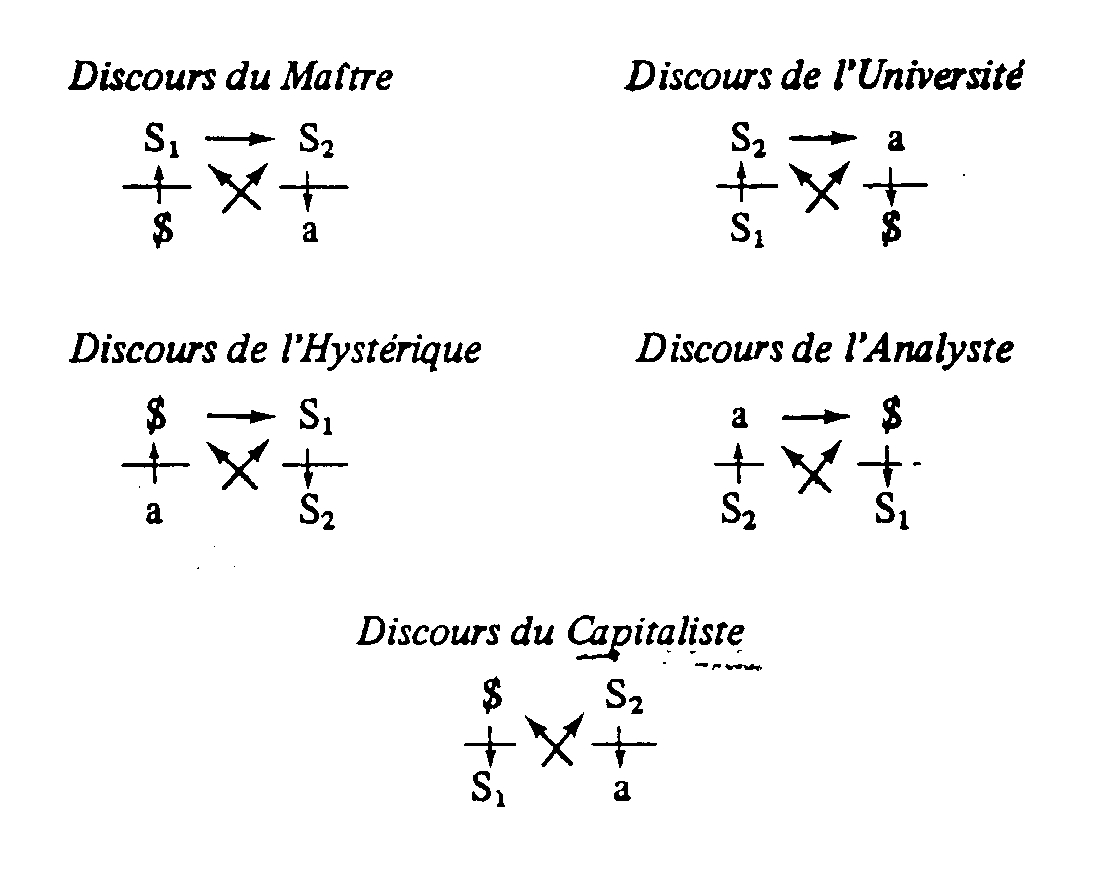
Fig 1One of the peculiar things about Lacanian psychoanalysis is that it is implicitly, potentially reflexively self-critical. One of Lacan’s conceptual devices helps us to understand a bit better exactly how recuperation operates under new mediatised conditions of possibility for political discourse. I have in mind the so-called ‘discourse of the capitalist’ (Fig. 1), though I am not sure that it is actually a fifth discourse that runs alongside the other four discourses that Lacan describes (Tomšič, 2015). In Seminar XVII Lacan (1991/2007) describes four discourses in one of his few extensions of psychoanalysis beyond the clinic, to understanding the political-economic context for the psychoanalytic clinic. These discourses are, discourse of the master as foundational, foundational condition of consciousness; discourse of the university, bureaucratically pretending to include all knowledge; discourse of the hysteric, productively rebellious questioning; and discourse of the analyst, hystericizing, facilitating critique. The so-called discourse of the capitalist that Lacan (1972) briefly proposes is a twist on the discourse of the master in conditions of commodity production and, I would say, of its mutation into the society of the spectacle. Here in this discourse, the barred subject is in the position of the agent, as if we are in the discourse of the hysteric, but it faces knowledge, the battery of signifiers as other. Underneath the barred subject in the position of truth is S1, master signifier, facing the objet petit a, product (Vanheule, 2016). The master signifier is where it would be in the discourse of the university, but the end-point of this is still a commodity, as it would be in the discourse of the master. So, the discourse of the capitalist is a diagnostic tool complicit in power.

We could re-label this fifth discourse ‘the discourse of psychoanalysis’, as Lacan himself implies it is. This is not the discourse of the analyst; no element is in the same position that we find in this mutation of discourse and the discourse of the analyst, but there is some significant mapping of elements with positions in the other three discourses, especially, of course, with the foundational discourse of the master. Here it is as if the agent, hysterical barred subject, is rebellious, questioning, but this agent attacks not the master but knowledge as such, rails against all knowledge, treating it as fake news. This agent revels in their division, aware of the existence of something of the unconscious in them, loving it; they are psychoanalytic subjects, ripe for analysis, up for it. It is as if the truth of this subject will be found in the little significant scraps of master signifier that anchor it, signifying substance that seems to explain but actually explains nothing. This is how memes function in the imaginary production and reproduction of politics. This kind of truth includes those signifiers that are cobbled together from our own psychoanalytic knowledge, rather like the way they function in the discourse of the university, chatter about the ‘ego’ and the ‘unconscious’ and the rest of the paraphernalia. Two key elements of the discourse of the master are still in place; knowledge as a fragmented constellation of memes mined for meaning, for signs of conspiracy or, at least, something that serves well enough as explanation, including psychoanalytic explanation; and there is the product, objet petit a, something lost, something that escapes, something that drives us on to make more of it. We know well enough the paranoiac incomplete nature of the psychoanalysis that lures us in and keeps us going; here it is again (Parker, 2009). We can draw on the discourse of psychoanalysis to make sense of Trump, and, more importantly, how he is represented.

This discourse is one manifestation of an ‘age of interpretation’ that now circumscribes and feeds psychoanalysis. Remember that Freud did not discover the unconscious, Lacan insists on this; rather he invented it, and that invention which is coterminous with burgeoning capitalism in Europe functions (Parker, 2011). It functions not only in the clinic, but in society. When it flourishes, its prevalence as an interpretative frame poses questions for psychoanalytic practice. Psychoanalytic subjects love psychoanalysis, love psychoanalytic discourse, they want more of it, want to speak it in the clinic and want to hear it interpreted, want it fed. The questions they pose in the clinic demand certain kinds of answers, psychoanalytic answers. In what Jacques-Alain Miller (1999) calls the age of interpretation there is a real danger that the analyst buys into this, feeds the unconscious. The appropriate analytic response to this demand is not to ‘interpret’ but to ‘cut’ the discourse, to disrupt it by a particular kind of interpretation, intervention which includes cutting the session. This is also why psychoanalysis should not be merely ‘applied’, for it will merely feed what it is being applied to. These conditions of discourse call for different kinds of interpretative strategies.

There are implications of this for what we think is psychoanalytic critique of meme-politics. Mere description won’t cut it. Perhaps it calls for what Robert Samuels describes as an ethic of neutrality combined with an ethic of free association; that is, neutrality of the analyst which does not rest on empathic engagement, and free association which does not feed the fantasy that something must be censored in order for correct speech to emerge. I’m not sure this will work. Perhaps it requires performative description in which there is some kind of over-identification with the discourse and unravelling of its internal contradictions; that is, deliberate use of the terms used, memes turned against memes. In which case we risk falling into the trap that Angela Nagle describes, one in which we replicate the conditions in which the alt-right emerged triumphant. Perhaps what we need is direct critique grounded in other forms of discourse, not only the discourse of the analyst which might work in the clinic but merely hystericizes, usually unproductively hystericizes its audience when it is ‘applied’ outside the clinic. Other forms of discourse, from Situationist critique and feminism and Marxism are necessary to break from the discourse that keeps all this going. Lacanian theory can connect with those other kinds of discourse as I have tried to show. This kind of anti-Trump in the media critique needs also be anti-psychoanalytic.

So, how do we speak as psychoanalysts about Trump? We can attend to the way that psychoanalytic discourse is mobilised in the public realm, but we need to take care not to simply feed that discourse. We should not pretend that we can speak as psychoanalysts. In fact, to speak as a psychoanalyst in the clinic is itself a performative impossibility. Lacan points out that what we say in the clinic may sometimes position us as psychoanalyst for the analysand, position us as subject supposed to know, but there is no guarantee that we are speaking there to them as a psychoanalyst. To pretend to speak from the identity of psychoanalyst is to speak as if we are a subject who does know. And so, then, to speak as if we are a psychoanalyst with a privileged position to interpret political phenomena in the public realm is to perform a double-betrayal of psychoanalysis itself. Words are weapons, Trump knows that. Psychoanalysis is a double-edged weapon, and so we need to take care over how to use it to speak about politics, including how we speak about Trump.


References

Debord, G. (1967/1977) Society of the Spectacle. Detroit: Black and Red.

Freud, S. (1905) ‘Jokes and their relation to the unconscious’, in J. Strachey (ed.) The Standard Edition of the Complete Psychological Works of Sigmund Freud, Vol. 8, London: Vintage, The Hogarth Press and the Institute of Psycho-Analysis.

Lacan, J. (1991/2007) The Other Side of Psychoanalysis: The Seminar of Jacques Lacan, Book XVII (translated by R. Grigg). New York: Norton.

Lacan, J. (1972) ‘On psychoanalytic discourse’, http://www.lacanianworks.net/?p=334

McLuhan, M. (1964) Understanding Media: The Extensions of Man. New York: McGraw Hill.

Miller, J.-A. (1999) ‘Interpretation in reverse’, Psychoanalytical Notebooks of the London Circle, 2, 9-18.

Nagle, A. (2017) Kill all Normies: Online culture wars from 4chan and Tumblr to Trump and the alt-right. Winchester and Washington: Zero Books.

Parker, I. (1997) Psychoanalytic Culture: Psychoanalytic Discourse in Western Society. London and Thousand Oaks, CA: Sage.

Parker, I. (2009) Psychoanalytic Mythologies. London: Anthem Books.

Parker, I. (2011) Lacanian Psychoanalysis: Revolutions in Subjectivity. London and New York: Routledge.

Salamy, E. (2017) ‘Create your own Trump-signed executive order with online generator’, Newsday, 5 February (accessed 29 February 2018), https://www.newsday.com/news/nation/create-your-own-trump-signed-executive-order-with-online-generator-1.13066643

Samuels, R. (2016) Psychoanalyzing the Left and Right after Donald Trump: Conservativism, Liberalism, and Neoliberal Populisms. London and New York: Palgrave Macmillan.

Tomšič, S. (2015) The Capitalist Unconscious: Marx and Lacan. London: Verso.

Vanheule, S. (2016) ‘Capitalist Discourse, Subjectivity and Lacanian Psychoanalysis’, Frontiers in Psychology, 7, https://www.ncbi.nlm.nih.gov/pmc/articles/PMC5145885/

Wolff, M. (2018) Fire and Fury: Inside the Trump White House. New York: Henry Holt.


This paper was published as a chapter as Parker, I. (2019) ‘Memesis and Psychoanalysis: Mediatising Trump’ in A. Bown and D. Bristow (eds) Post-Memes: Seizing the Memes of Production. Goleta, CA: Punctum Books, pp. 351-364. [ISBN-13: 978-1-950192-23-6] [doi: 10.21983/P3.0255.1.17] You can download the whole book at this link: https://punctumbooks.com/titles/post-memes-seizing-the-memes-of-production/


This is one part of the FIIMG project to put psychopolitics on the agenda for liberation movements


Coronavirus as a symptom

David Pavón-Cuéllar writes:


It has become commonplace to say that the coronavirus pandemic has also been a pandemic of panic, stress, anxiety, ignorance, selfishness, racism, hatred, and even loneliness. This “diagnosis” should not be underestimated. It is not just a metaphor.

The metaphor is the coronavirus. The virus is like a Freudian condensation of the various personal and social experiences associated with the pandemic. These experiences have been assimilated into the viral agent that represents them metaphorically.

The coronavirus is a metaphor for everything we are living through, suffering, and fearing, just as gold is a metaphor for value, money, a sunburst, or the colour of blond hair. Just as blond hair and richness could be symbolized by gold in a dream, so too, the virus could now serve as a dream symbol of our fear and loneliness. It is as if what we are living has the form of a virus.

The coronavirus becomes the metaphorical representation of our existence in the pandemic. We must understand well that we are what the virus means. With its metaphorical structure, the coronavirus is like a dream symbol. It is the condensed symptom of what we are, live, feel, and suffer.

Each one suffers their own symptom. Each one has, as Lacan would say about the symptom, their own “knowledge about oneself,”1 their own “enjoyment of the unconscious,”2 and their own “opaque enjoyment of excluding meaning.”3 In other words, each person has their own coronavirus.

There are as many different coronaviruses as there are different subjects. We could classify them into structures. Each structural configuration would then correspond to a particular manifestation of the viral agent as a symptom of our irreducibly unique existence.

The phobic coronavirus causes us to panic and makes us avoid information about the pandemic. The obsessively neurotic coronavirus forces us to scrupulously maintain good sense and realism, to consult endlessly as to the numbers of infections and deaths, but also to “take terribly protective measures against infection,” as Lacan says when pretending to quote Freud.4 The perverse coronavirus gives us a good pretext with which to attack nurses, burn down sick houses, or prevent the installation of hospitals. The normopathic coronavirus leads us to take advantage of the situation by enriching ourselves through financial profit, either by speculating in the stock exchange, buying and reselling face masks, or increasing the prices of ventilators or disinfectant gel.

The melancholic coronavirus comforts us with the certainty that the planet is finally beginning to get rid of something as despicable as us humans. The paranoid coronavirus makes us believe not in the news, but in conspiracy theories as we think that confinement is a ploy to control us or that the virus is either a biological weapon invented in laboratories or an effect of the fifth generation of mobile networks. Meanwhile, the hysterical virus alternately causes us to be suggestible, to sneeze, yawn and sigh, to long for lost contacts, or to console ourselves with computer screens, indulge in the spectacle on social networks, enjoy the pleasures of confinement and oscillate between boredom and desire, between love and heartbreak at a distance, and between despair and hope in the imminent revolution and end of capitalism.

The various coronaviruses could be easily exemplified by the political leaders of the world and the great intellectuals who have spoken on the subject. Perhaps we have the right to have a little fun by thinking, for example, about the hysterical coronavirus of Žižek, the obsessive of Han, the paranoid of Agamben, and so on. It would be interesting to continue this, but it is not the most important thing.

What matters is that the various coronaviruses have something in common. This commonality is, first, our shared existence in the capitalist world in which we live. It is, however, also capitalism itself, which unfolds in our existence and, now, in its symptomatic viral manifestation. It is here, in the capitalist system, where Marx discovered the notion of “symptom” that will later be applied in psychoanalysis, as Lacan has well noted.5

On the one hand, as a symptom of our existence in capitalism, the coronavirus is revealing to us our loneliness in alienation; that is, for Lacan, the only “social symptom”, the one of our “proletarian” condition, for which we do not have “speech to tie between us.”6 On the other hand, as a symptom of the capitalist system, the virus itself is like a lens that reveals much of capitalism. These revelations include the devastation of nature that destroyed the ecosystem in which the viral agent was trapped, the contempt for human life that has caused thousands of infections and deaths by not shutting factories and shops in time, and the inequality that opens a gap in each society between the lucky and the damned, between those who can confine themselves and those who must continue working, and between those who have and those who lack medical care, hospital beds, respirators, and other requirements for survival.7

Everything revealed by the “coronavirus of capitalism,” as I have called it elsewhere,8 must be heard. Real listening, as psychoanalysis teaches us, requires us to act accordingly. The resulting anti-capitalist action must leave Han behind, avoid Agamben’s wall, and reach the Žižekian hysterical point where the impossible is recognized. For the impossible to become the real that it could be, however, we must go further and follow Marx when he prescribes that we face, “in a practical way,” those problems that we cannot solve in theory.9


References

1 Jacques Lacan, Le séminaire, livre 12, Problèmes cruciaux pour la psychanalyse. Unpublished. Class of the 16th June 1965.

2 Jacques Lacan, Le séminaire, livre 22, RSI. Unpublished. Class of the 18th February 1975.

3 Jacques Lacan, Joyce le symptôme, in Autres écrits (Paris, Seuil, 2001), p. 570.

4 Jacques Lacan, Le séminaire, livre III, Les psychoses (Paris, Seuil, 1981), p. 281.

5 Jacques Lacan, Le séminaire XVII, L’envers de la psychanalyse (Paris, Seuil, 1991), p. 235.

6 Jacques Lacan, La troisième, intervention au Congrès de Rome, Lettres de l’École freudienne 16, 1975, p. 187.

7 David Pavón-Cuéllar, El coronavirus como síntoma del capitalismo, Rosa, una revista de izquierda, http://www.revistarosa.cl/2020/04/06/el-coronavirus-como-sintoma-del-capitalismo/

8 David Pavón-Cuéllar, El coronavirus del capitalismo, Lacanemancipa, 28 de abril 2020, https://lacaneman.hypotheses.org/1532

9 Karl Marx, Manuscritos económico-filosóficos de 1844, in Marx y Engels, Escritos económicos varios (Ciudad de México, Grijalbo, 1966), p. 87.


This paper by David Pavón-Cuéllar was first published in Lacan Salon.


This is one part of the FIIMG project to put psychopolitics on the agenda for liberation movements


Mornington Crescent moments

There is no overarching rule that determines or predicts how rules can be broken, but it is possible to notice, after the event, how a certain sequence of interactions has given rise to a moment when something new could happen. One way of capturing this moment is provided by a game on the BBC radio programme I’m Sorry I Haven’t a Clue called ‘Mornington Crescent’. However, the fact that it is a game also draws attention to the automatic repetitive aspect of the process, so that while ‘Mornington Crescent’ names an ‘event’ of some kind that could not be predicted at the outset, it can also permit the voicing of formulaic ‘interventions’ that simply succeeded because they arrived on time instead of providing some new content. The Mornington Crescent moment can be exhilarating when it marks an eruption of the unexpected, even when it functions as the sign of an act, and it can be deadening when arrives at its appointed hour, an old train en route to the same old station. It is a moment when something psychological happens that is not inside subjects but between them.

How does it work? Mornington Crescent is a subway station in London. In the game participants produce an unscripted series of names of other London subway stations, a list that could include names of streets or landmarks. There is no prescribed sequence of speakers, and one simply says the next name to produce the series when there is space to do so. This means that the rhythm of the series can sometimes lag a bit, feel a bit flat, and at other times the pace can be rapid with a strange energy to the interchange. But there comes a moment when the participants arrive at Mornington Crescent, when one will produce this signifier which will punctuate the series, will end it. To say ‘Morning Crescent’ too early will be crass, inopportune and to wait too late will be to fall prey to the sense that there has been degeneration into dull routine. There is a hesitant and sometimes tense intersubjective aspect to the game.

One can notice this moment in traditional left political meetings, particularly committee meetings when someone finds exactly the right moment to point out that, say, no women have spoken yet. Usually they are right, but that’s not the point in terms of the game. The point is to seize the right moment to make the point. This moment, which sometimes provokes exasperation or guilty recognition, can be extended ad infinitum to draw attention to lack of speakers from this or that identity category or member of a group that is subject of the discussion or, in some variants, an ‘ordinary’ member of the public who should be included. To point it out too early will lead to it being easily dismissed, and to wait too long will have enabled some other member of the group to anticipate the point in another contribution and inoculate the group against it. You need to strike at the right moment. Such moments are necessary, but often merely indicate that one speaker has seized a moment rather than introduced something radically new to the discussion.

And, with a different more radical valence, Mornington Crescent moments appear in the wider political field, exemplifying a space of freedom for things to be said that could not be said before, to be said now before it is too late. When is the right moment to break from the government narrative that ‘we are all in it together’, for example, and to do that in a way that strikes a chord? It was always right to say that, just as it is always right to argue that, in principle, a general strike is needed, but most times to simply repeat the demand for a general strike sounds stupid. We need to say it just at the right moment. Maybe the moment appears at another break in politics, another break that shakes things and makes it possible to speak in a different way about things. Maybe now? Then there is a possibility that another world is possible has appeared within the frame of everyday life. Then a London subway station has appeared in political discourse.


This is one part of the FIIMG project to put psychopolitics on the agenda for liberation movements


Believe it or not!

I Want to Believe: Posadism, UFOs and Apocalyptic Communism by A. M. Gittlitz published by Pluto, reviewed by Ian Parker

In 1962, just as the Fourth International was preparing its reunification congress, which took place the following year, an Argentinian Trotskyist Homero Cristalli seized control. His Buró Latinoamericano (BLA), the FI’s Latin American Bureau, expelled all European sections of the International and replaced them with a ‘European Bureau’ which he personally directed. A new Fourth International was declared at an emergency congress in Montevideo, Uruguay, and it was from here that Cristalli ran his operation under the pseudonym ‘Juan Posadas’; thus was born the Cuarta Internacional Posadista.

A. M. Gittlitz tells the story of the rise of Cristalli from being a shoemaker, union organizer, league footballer and singer of tango classics to being leader of an international organisation that implanted itself in most countries of Latin America and many others around the world, with local leaderships that were usually Argentinian or Uruguayan. There were sections in Europe including, in Britain, the Revolutionary Workers Party led by miners, and the book traces the emergence and disintegration of these groups as Posadas became increasingly erratic, taking us up to his death in 1981 and beyond, to his son León Cristalli’s attempts to keep his thought alive and to a strange afterlife of Posadism on the Internet.

What Gittlitz does so well in weaving the life of Posadas with the enclosed parallel universe of Trotskyism he created is to embed that life in the particular conditions of possibility for the development of revolutionary movements in Argentina in the immediate aftermath of the Second World War. Not everyone ended up like Posadas and not every group became Posadist, but we can understand what happened better if we understand that context. Gittlitz describes the local context, the global situation and some of the key debates in the main Trotskyist organisations.

These were times of imminent threat of nuclear war intensified by the Cuban missile crisis after the successful unexpected revolution, and of a space race between the United States and the Soviet Union, which had succeeded in sending Yuri Gagarin up in a rocket in 1961 and which, as Gittlitz describes in some detail, had a long history, back to Lenin and Trotsky, of intense engagement with technology and even speculation about life on other planets. The US SETI (Search for Extra-Terrestrial Intelligence) programme included advocates not only of communicating with alien life forms but also with dolphins. There were many sightings of UFOs in Argentina, and much popular discussion about what they were and what they portended, and there was Peronism, a peculiar blend of quasi-fascist populist rhetoric and incorporation of trades unions into state power that divided the revolutionary left.

There are plenty of amusing anecdotes in this well-researched book, one of which indicates the high stakes and macho braggadocio that ran through the rival revolutionary organisations bidding to become sections of the Fourth International in Latin America after the Second World War and before 1962. One contender for leadership of the Latin American Bureau, who eventually became part of the mother-ship, Nahuel Moreno, claimed, in a meeting with Posadas during a meeting of the Argentinian POR, that he had read all three volumes of Marx’s Capital; not to be outdone, Posadas shouted that he had read six. The underlying question was who would rule the roost.

Populism and power

It was that last aspect of Peronism, authoritarian populism, that fed the imagination of Posadas, and so one of his most powerful and lasting deviations from Marxist organisational practice was what he called ‘monolithism’. In place of democratic centralism – democratic debate and application of a common line by the organisation – was the direction of the party, and all parties in the Cuarta Internacional Posadista, by the leadership, by Posadas himself. That leadership was abusive and dictatorial, entailing humiliation and expulsion of dissidents and control of women, including the demand that wives and girlfriends must be members of the party and, almost inevitably, that they be available to sleep with Posadas.

Gittlitz weaves another technological element into his story of the rise and fall of Posadas, the invention of the tape recorder, which enabled the great leader to speak for hours on end and to dream up new theoretical innovations as he spoke. It was something like the opposite of psychoanalysis; here it was free association driven by the belief that everything that was said was true, and must be told to the world. It was not Posadas who began to speak about flying saucers, but one of his followers Dante Minazolli who insisted on the question; one that Posadas answered with the suggestion that other planetary civilisations advanced enough to arrive on Earth must, by definition, be socialist. The suggestion became a fetish, and made the Posadists the laughing stock of the rest of the left, and out of that spun other SETI-like ideas, about talking with dolphins, for example. That is what he is most remembered for now. Minazolli continued to propagate these ideas, and there were radical attempts to intervene in UFO-watching circles, after Posadas’ death.

It is here that Gittlitz spins a little too easily into common characterisations of the Posadist problem as to do with his mental health, something that leaders of the Fourth International who had to deal with him before 1962 had already rehearsed. We are told that the tape recorder allowed Posadas to convey his ideas more easily, for example, because writing was hindered by his ‘attention deficit disorder’; later his ‘mania’ increased, and his paranoia, and the narrative leads logically to his later ideas being plain ‘crazy’, culminating in his death-bed claim that although he may die, he would, he assured his followers, rise again.

In some ways Gittlitz is too hard on Posadas and in others too easy. From his own account we can see that the melange of weird ideas that made up the stuff of Posadism was quite understandable. In other times in other contexts, some of them could be articulated with revolutionary Marxism. Posadas’ signature claim, one that really underpinned the formation of his own Fourth International based in Montevideo, was that nuclear war was going to happen, and that it would be better if the Soviet Union was to launch a pre-emptive nuclear strike so that from the wreckage some socialist future might be built. It was a stupid political line, and one that led to a break with the Cuban regime, of course, where the Posadists, the only Trotskyists in the island, were then suppressed.

But, for all this exaggerated threat and fervent belief in the onward march of humankind, it was actually a line that was not so very far from that argued by Michel Pablo, secretary of the Fourth International. The world was changing fast, and was under threat, and revolutionaries were struggling with what to make of that situation. Posadas ability to take complete control is something that ran contrary to the dynamic of Trotskyist politics, and we do not need to resort to diagnosis of him being ‘mad’ to formulate a thorough critique of his methods, something that would be helped by a good dose of revolutionary socialist feminist theory of organisation.

After Posadas

León Cristalli is still churning out stuff in memory of his father in Argentina, but the only functioning Posadist political organisation in the world now is in Uruguay. I visited the headquarters of the Partido Obrero Revolucionario (Trotskista, Posadista), POR, in Montevideo last year, and had a friendly chat with comrades there. The POR was founded in 1944, with continuous existence, the very same organisation that was seized by Posadas in 1962, and which became an active part of the progressive Frente Amplio which governed the country from 2004 until a few months ago. They were happy to meet someone from the International they had left so many years ago, but blanked me when I asked them about revolutionary nuclear war.

What Gittlitz omits from his account, and there is the very briefest mention of the group in Montevideo in which he indicates that they didn’t want to wax lyrical about Posadas to him either, is the very difficult journey that some leftists have had to make through Posadism and out the other side, back into socialist politics again. Posadas’ homophobia, his misogyny and his moralistic control of the personal lives of party members is now but a bad memory. The POR shop-front was sprayed with fascist graffiti; the organisation had recently come under attack because of its support for progressive Frente Amplio legislation over LGBT rights.

Although it was buried deep in that broad front, the POR also sold Posadist pamphlets, including those that claimed that the nuclear war had happened, but through other means like Swine Flu, and it called for support for the ‘regenerating’ socialist states, including Russia, China, Cuba and Venezuela. One Posadist publication edited by León Cristalli included two articles by Vladimir Putin. Again, these are political questions, mistakes and debates that cannot be written off as signs of madness, for there is much the same in much propaganda among our divided left.

This book is zippily written, more engaging than most histories of the Fourth International, but with some political formulations that will jar for some, including the brief description of the Bolsheviks seizing power and establishing a dictatorship. No, it is not as simple as that. The Russian Revolution was contradictory; an opening, which was fought for by Lenin and Trotsky and present in the later debates about democratic centralism, and a closure around Stalin and the bureaucracy in which the centralist aspect took precedence and blotted out democracy altogether.

Overall the political tone and line of the book is not so much concerned with retrieving a revolutionary history from the Posadas debacle but transcending it. Gittlitz looks back, sometimes with a too-mocking journalist gaze, on these sorry episodes in the history of our movement and the lessons they hold for the way we organise now, finding some redemption only in whimsical intergalactic Posadist memes that circulate on Facebook, seeing in those an opening to the ‘otherness’ of other forms of life. It is as if Homero Cristalli did all these bad things but at least he made for some good jokes about old Marxism.

The book is well worth a read, and might even bring some new activists into first contact with Trotskyism, which is what Gittlitz does claim at some points, but is rather too quick to play up the ‘fun’ aspect of Posadism. You will learn many things about Posadas that you didn’t already know. Posadas, apparently, had his own theory of humour, declaring that while jokes are a function of contradictions under capitalism, under socialism jokes would no longer exist. Posadism itself was not funny, but tragic, and when we laugh at it we do need to ask ourselves what we are doing and what we are failing to learn in the process.


You can read and comment on this article here


This is one part of the FIIMG project to put psychopolitics on the agenda for liberation movements